*I was browsing through my files and saw the term paper I wrote for my film class. :) It's 15 pages long. I am going to delete the file already so I'll save a copy of it here in my blog.
The Asian region is probably one of the most influential regions in the world, not only because of the economic relevance of the country that it consists but also because of the wide array of cultures that are distinct from one another which can aptly represent both ends of the spectrum. Asian culture is commonly represented in mainstream media especially in films and news. Various products and masterpieces have been released, focusing on Asian tradition and values and some of these portray the sexual inequality among men and women in Asia.
The purpose of this paper is to examine the stereotyping of gender roles in contemporary films about the East Asian culture. Two movies will be discussed side by side to show the similarities and differences of East Asian gender roles in the perspective of Asian filmmakers and their Western counterparts. This paper tries to argue that certain films lose the value of the messages it tries to convey by simply adjusting the aspects for marketability and popularity in the box office. Moreover, most films contain stereotypes of the male and female images perpetuated by the existing social norms. Most of these stereotypes revolve around male supremacy and reduction of women as an object of sexuality and fetish to satisfy men. It is, however, understood that this paper cannot be generalized because it only uses two films for comparison namely Raise the Red Lantern (1991) and Memoirs of a Geisha (2005)
Raise the Red Lantern: Sexuality and the Locus of Power
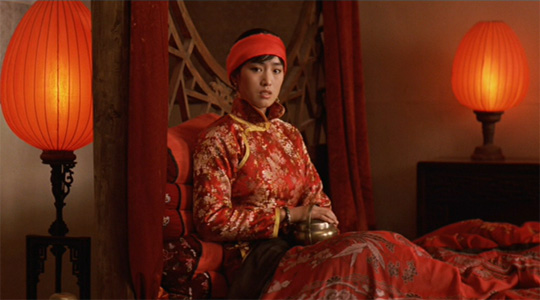
 Raise the Red Lantern is a brilliant masterpiece of the internationally-acclaimed Chinese director Zhang Yimou. This 1991 film, starring Gong Li as the young and determined Song Lian, was based on a novel written by Su Tong entitled Wives and Concubines. Set in 1920’s Northern China, Raise the Red Lantern was about the life of Song Lian, a college student who was married off to a rich man who belonged to the Chen family after her father died and left them in debt. With hopes before of making a better future for herself with the use of education, Song Lian finds herself trapped in the confines of the house, where tradition and familial rules reigned and where her education was definitely out of place because all the things happening around her contradicted everything that she acquired from school.
  The plot thickens as Song Lian discovers how putrid the existing system in the house is and realizes the complicated web of suspicions and deceit this system creates among the four wives, who are each competing for the “master’s ” attention and favour. She finds out that no one can be trusted because each and every one of the wives has no other motive than to compete for the red lanterns which symbolized the seat of power and control in the house. Joining in the competition, Song Lian feigns pregnancy in the hope of receiving the master’s full attention while cunningly plotting to make her non-existent pregnancy come into actuality. This act however was thwarted when her personal maid, who was secretly in love with the Master Chen and was in league with the Second Mistress, finds her bloody clothing and tells on her.
 As the story progresses, we see how Song Lian transformed from an idealistic and hopeful university student to a woman suffocating from the rules she had to follow, seeing the competition between the wives as a shallow endeavour that is really irrelevant to the essence of her existence. She withdraws herself from the rest of the world, settles in solitude and refused to do anything anymore to gain the master’s favour. She gets drunk one night and blurts out about the illicit love affair between the Third Mistress and the family doctor. The scheming Second Mistress hears about this and immediately runs to tell the Master Chen. Based on family tradition, the Third Mistress had to be murdered in a small room atop the house. Song Lian witnesses this and is extremely shaken and traumatized because of what happened. The movie ends in a scene where the newly-arrived Fifth Wife sees Song Lian wearing her student clothes and wandering aimlessly in her quarter, apparently losing her sanity.
The reception of the film by the international community was overwhelming. It was said that the film “cemented Zhang Yimou’s status as a leading figure in world cinema and reaffirmed the vibrancy of Chinese cinema” (Brenner, 2010). Although the film gathered a lot of controversies, one being the fact that it was banned by the Chinese government for supposedly “indicting” the status quo and implicitly criticizing the Communist Government, it was still considered one of the most beautiful films ever created in Asian cinema. It earned a lot of nominations including the Best Foreign Language Film for the 1992 Academy Awards and Golden Lion for Best Film for the 1991 Venice International Film Festival. It also won several international awards such as the Best Foreign Language Film for the 1992 New York Film Critics Circle and the Silver Lion for Best Director in the 1991 Venice International Film Festival.
 The movie represented a lot of issues in society including the hierarchies of gender and power, the longstanding debate about the preservation and relevance of tradition and rules as well as the topic of submission and tyranny of the existing institutions in China (or any place in the world, for that matter). It was said that the movie tells about “an archaic system that rewards those who play within the rules and destroys those who violate them” (Berardinelli, 1996). Although Yimou denies allegations that it was a subtle critic of how the Chinese Communist Party runs the country – Song Lian representing the individual; the Chen Household representing the repressive and despotic “government” and the House Rules as the laws of the land – several movie critics and reviews insist that the movie had a hidden political message concealed in the interlocking subplots of the film. (Berardinelli, 1996)( Heiter, 2004) ( Wilkinson, 2006)
 Putting the governmental critique of the film aside, we can also see the evident power play of gender roles in the film. The images of the four women were juxtaposed with the image of this faceless man who emanated so much power that he can define the status of each woman in the house. In his hand lies the fate and status of the four wives and he alone can determine the temporary locus of power in the household. If we take this imagery out of the film and put it in plain black and white, we can evidently see the hierarchy of power among gender that is being perpetuated by the status quo. This is typical of the East Asian treatment of the female gender as inferior to the male gender. The male gender is the all powerful symbol whereas the female gender only depends on the former to define her position in the sphere of interaction in society.
 The film showed several critique of the existing norms in the Chinese society, more specifically the oppressive Confucian tradition. According to Neo (2004), Yimou brilliantly uses the Confucian/feminist matrix in the film which “highlights the ineffectualness and oppressiveness of the Chinese Confucian System”. Confucianism, which is a patriarchal ideology, emphasizes on rigid class and gender delineation, heavy priority on male heir and importance of traditions and customs. In Confucian tradition, women are treated as objects and are not free to make the major choices in their life. They are used simply to satisfy the sexual appetite of men and provide a vessel for a male heir. Therefore, “when women gain their identity and stations in life from this oppressive structure, they in turn, gain satisfaction from enforcing these customs and rules on less powerful women” (Neo, 2004)
 Several objects in the film showed male supremacy in the Chinese Culture. The foot massage was utilized as a fetish for both the patriarch and the wives.Thematically, it was a symbol of power and privileged, given to the woman because the master chose to spend the night with her. As Neo (2004) points out, the woman is paradoxically the mechanism by which the man achieves phallic wholeness, from and through which he derives pleasure; yet at the same time renouncing it. The number of wives was also another form of fetish for the man as a greater affirmation of his masculinity. The affair of the Third Wife served as a threat to the existing patriarchal system because she “assumes the ‘phallic’ power that men enjoyed and should therefore be removed or executed. Fetishes were rooted from a fear of castration and the execution of the “threat” represented the ultimate form of castration in the society. The foot also represented another aspect of male dominance because of the undeniable metonymic relationship between the foot and sexuality in Chinese Culture. It has always been believed that a smaller foot is correlated to a smaller vagina, which is in turn better for men. Foot-binding among rich women were done to keep them idle and controlled by men. The foot massage served as a symbol for the foot-binding tradition. It was seen less as a reward for women because it greater serves the interest of the Master Chen by being a type of “foreplay” for the vagina as a “receptacle for the penis”. (Fong, 1995:16)
 Another object regarded as fetish was Song Lian’s flute. Aside from having a phallic shape, flute symbolized education and learning in Chinese culture and only men had the right to play it. The flute represented the education that Song Lian had and which the other wives were deprived of. It was a symbol of power. She had the flute but the patriarch takes it from her, thereby emasculating her and “reducing her to the level of the less educated wives” (Neo, 2004) However, it is also very interesting to point out how Yimou brilliantly shows the way in which the male gender can be easily manipulated by the female image by utilizing a combination of pure wiles, sexual pleasure and the very concept of male supremacy in order to get what she wants. We have seen it in Song Lian’s feigned pregnancy as well as when Song Lian was just a new concubine in the Chen household. Men have an apparent weakness when presented with options for sexual pleasures, which in essence, reduces the image of the woman into a mere sexual object for the benefit of the masculine race. Female sexual prowess can bestow a woman huge amount of power. Bearing a male child also bestows a huge amount of power to a woman. Yet, these cases are still male-biased because the concept of power is still pegged on the notion of masculinity i.e., the importance of men’s attraction and the male offspring respectively.
***************
Memoirs of a Geisha: Asian Sexuality in the Eyes of the West

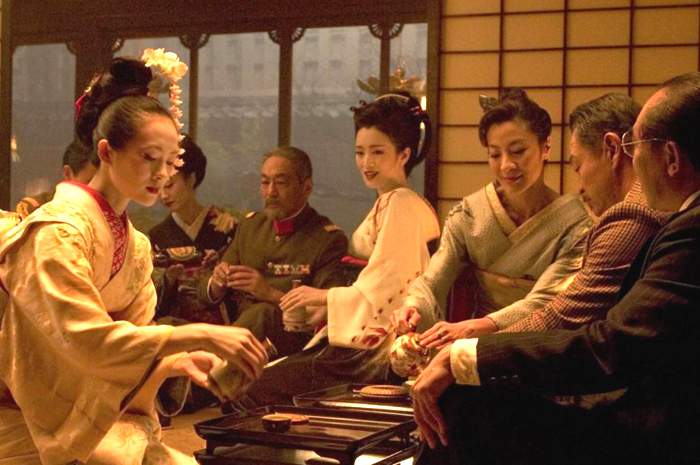
The word Geisha is a combination of two Japanese words: gei which means person and sha which means arts or performance. In short, a geisha is a person that performs Japanese traditional art. These are women who wear heavy white make-ups that completely conceal their faces and are trained to perform important Japanese traditional skills such as conducting a tea ceremony, singing and playing traditional musical instruments, dancing (usually with the use of colourful fans), chanting poems and being experts in wearing traditional Japanese kimono. Since the early 1950’s, Geisha art became known worldwide which also stimulated the rise of geisha-related novels, one of which includes Arthur Golden’s Memoir of a Geisha. This anecdote of a geisha’s life was based on the life of a real geisha who once lived in Kyoto during the 1950’s[i].  The novel was catapulted to fame because of the surrounding controversies [ii] as well as the rich details it contained about the mysterious life of a geisha. It was later adapted to the big screen by Rob Marshall in 2005. The film of the same title starred Zhang Ziyi as the movie’s heroine, Chiyo Sakamoto (who changed her name to Sayuri Nitta). Some people have the certain misconception that the film is Asian because the plot, the actors and the settings of the movie are heavily Asian but in reality it is a Hollywood-produced movie, conceptualized and written by Western filmmakers.
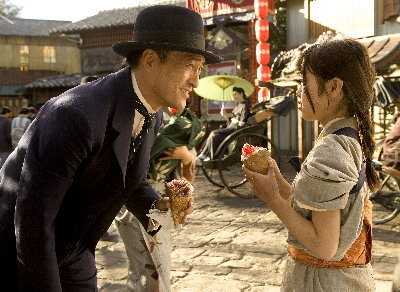
 The story begins with Chiyo and her older sister Satsu being sold by their father for lifetime servitude in Kyoto. Chiyo was sold to an okiya (geisha home) while her sister was sold to a whorehouse in downtown Kyoto. Chiyo immediately poses a threat to the status of the okiya’s prized geisha Hatsumomo (Gong Li). She constantly abuses Chiyo to discourage her from pursuing a career as a geisha. Chiyo tries as much as possible to escape the terrible fate that had befallen her and tries to reunite with her sister but fails. One night, a drunk Hatsumomo and another geisha goaded Chiyo to stain a beautiful kimono that they stole from a rival geisha, Mameha (Michelle Yeoh). This cost Chiyo her chance to become a geisha and was sentenced to become a slave in the okiya until she was able to pay all the expenses that the okami (head of the geisha home) had spent for her. The story takes an interesting turn when the 15-year old Chiyo meets the Chairman of a Japanese electric company (Ken Watanabe) who gives her some money to buy candy. Chiyo became fond of the chairman and swore to herself that she will become a geisha if it is the only way to meet him again.
Taken under the care of the kind Mameha, Sayuri trained to become a geisha and eventually debuted as one of the most popular and wanted geisha in the Gion District. She became the rival of Hatsumomo who was hell-bent on destroying her life in every possible way she can. Sayuri was eventually reunited with the Chairman although Nobu, the latter’s close friend, also takes interest in Sayuri. Her good life was cut short by the start of World War II and the Second Sino-Japanese War. The Chairman secured the safety of Sayuri and Mameha but both had no choice but to work as rice field labourers in war-torn Japan. After the war, Nobu visited Sayuri and asked her help to entertain several American investors to help salvage their dying business. Sayuri consented and asked Mameha and Pumpkin, an old friend, to accompany her. The story ends with the Chairman revealing to Sayuri that he was behind everything that happened in her life that made her become a geisha. The two confessed their love for each other and the movie ends with them strolling in a beautiful Japanese garden.
The movie was a typical melodrama about the struggle of a girl (Chiyo) and how she arose from the challenges that she faced in life. It was a love story like any other which starts with a damsel in distress and a knight-in-shining-armour that comes along to save her.
The reception of the movie was mixed. Some controversies even arose around the casting of the movie saying that it was ironic because no Japanese actress was casted for the main roles and all of the important women roles were given to Chinese. The Chinese government banned the movie saying that it was offensive to the Chinese population because geishas are seen as prostitutes in China and it reminded them of their dreadful experiences in the hands of the Japanese Imperial Army during the war. (Chaw 2005)(Douglas 2005)
The casting marked an important part of the movie because of the symbolism and implications that it caused among the Chinese and Japanese community. It is common knowledge that Japan and China’s relationship has always been surrounded by tension tracing back to the history of the Sino-Japanese wars. The casting stirred a lot of emotions among both countries. First off, the male stars were Japanese actors who were portrayed as both active in the Second World War while the women (geishas) along side of them were portrayed by Chinese actresses. These brought up the memories of the Sino-Japanese war were atrocities were committed by Japanese soldiers while they were colonizing Manchuria. Most Chinese women were used as “comfort women” by Japanese soldiers. This slight resemblance was one of the reasons why the film was accepted negatively, if not banned, in China. It was also said to have been offensive for Japanese people because no Japanese actress were casted for the main roles and instead, geishas were portrayed by three Chinese actresses.

We can see a strong reference to the masculine importance yet again in several recurring points in the movie. First off is the concept of
mizuage which became a competition for men.
Mizuage is the ceremonial deflowering of a
maiko to officially mark her transformation as a professional geisha. Although real life geishas, including Iwasaki, deny the movies representation of the concept of
mizuage, the movie still proceeded with it. It actually became one of the important turning points in Sayuri’s life. It determined the fate of Sayuri as a geisha because the deal between Mameha and Mother Nitta (the
okami) depended on the amount that Sayuri will get in her debut as a professional geisha. Moreover, we can also see the usual imagery of women as an object of sexual pleasure because at this point in the film, the allure of a geisha is based on her virginity. We can see how important a determinant it is when Dr. Crab (one of the bidders for the
mizuage) lost interest in Sayuri after Hatsumomo started to spread rumors that Sayuri is fond of sleeping with different men. Mameha tried to salvage Sayuri’s honor and fame by casting her in a groundbreaking dance presentation that captured all of the men in Gion’s interests. This represents how important the sexual characteristics of a woman and how significant they are in gaining control or getting the favour of men. It was also evident in Mameha’s words when she told Sayuri to preserve and protect her “cave” from any “eel” that will try to enter it before her
mizuage. Sexual advantage is the weapon of women in this movie to get what they want and advance in the hierarchy of power in society.

The gender distinction in the movie is present, with a clear delineation of what men and women can or cannot do. Men determine power and geisha’s compete for attention from these men because this is the essence of their job: to be mysterious yet alluring enough to the opposite sex. These characterize their femininity and in no way whatsoever can they have the freedom to do whatever they want to do. Men can refuse geishas but geishas cannot. They are in constant pursuit of men’s attention (a rich man that is) that is why they have to put the heavy make-up on and dress up in attractive kimonos as well as walk elegantly using those wooden sandals.
The main plot which focuses on Sayuri’s journey from a scrawny little girl to the most famous Geisha in Japan has been catalyzed by her affection to a man, the Chairman. Again, this is a display of how the feminine gender leans on the male gender to pave their way to success. Furthermore, the story reveals that it was the Chairman who asked Mameha to train Chiyo and fulfil her dreams as a geisha. This is a very masculine point of the film because it presents to us a scenario where the man is the impetus for the woman’s success. What does this tell us? That in real term, women are dependent on men to assist them in reaching their full potentials as a woman and as a person.
***********
Parallelism of the Two Films: Cross-cultural Examination of Gender Roles in Film Production

Memoirs of a Geisha (2005) and Raise the Red Lantern (1991) are two movies in Asian settings, both tackling issues of sexuality, social status and power struggle. Both were originally novels adapted into the big screen and are intentionally made to showcase the wonderful and exotic aspects of Asian culture. One film was directed by an Asian while the other was directed by an American. A close look at the movies and the multitudes of movie reviews tell us one thing: that the two movies differ in the supposed interpretation of the novels because of cultural differences. Marshall’s depiction of Golden’s 1997 novel reduced the intricate plot into a mere romantic post-war melodrama, whose main character is so detached from the viewers and is completely devoid of feelings and genuine rational aspirations. The original novel became famous for its touch of realism that could make the reader create a world in his own head about the geisha’s real life, something the film ironically lacked of. In contrast, Raise the Red Lantern was praised for its very good depiction of the novel and how it brilliantly takes the viewer into Song Lian’s world, complete with the feelings of suffocation and repression that the characters are feeling every single moment of the film. Unlike Marshall, it focused on the development of each character’s action, carefully weaving every scene into a complete masterpiece with no issues left unexplained or unresolved. This then raises the question of the degree to which a film adaptation can stray from the original plot from which it is based on. Is it okay to make changes in the film to enhance its marketability even if it is detrimental to the story?

Marshall was quoted to have said that he wanted to make
Memoirs as a fable. (Lee, 2005) But is this any excuse for a movie to stray away from the accuracy of the story? For one, the theme of the movie was about “geishas”, a real part of Japanese culture, and a symbol of their rich tradition. In the movie, geisha’s were not portrayed accurately and was shaped to fit the taste of the Westerners. Furthermore, it reduced Asian women into mere object of eastern exotic fantasies, equating geisha’s to prostitutes. It tries to remove the stigma of geisha’s as paid sex workers but it contradicts itself by highlighting the auctioning of Sayuri’s virginity. The extent of the movie’s inaccuracy reaches the costumes and dances that were used to portray a geisha. According to one review, the filmmakers decided that heavy white make up of geisha’s would not suit the taste of American audiences and so it was toned-down and westernized. The dance that Sayuri performed in a festival in Kyoto, the one that defined the fate of her
mizuage, overlooked original Japanese kabuki dances which is supposedly slow and graceful. Instead, it was more similar to Hollywood dances with its fast beats and use of spotlight. The costume design even mistakenly gave her an outfit appropriate for a
tayu (prostitutes)
[iii] . The details were compromised that it lost the essence it tried to portray: clarifying the image of geishas to the whole world. It was, as Lee (2005) pointed out, a portrayal not of a geisha but a McGeisha, catering to the Oriental fantasies of Western men about the exotic and mysterious eastern eroticism. Quoting one reviewer:
“
It confuses its message of female empowerment (it is, indeed, one of those pictures that suggests that forms of prostitution are feminism in full flower and practice) with fatalistic moments like those and lines like "what more can we expect, we Geisha?"--ignoring altogether the gangsters with their fingers in every Geisha school at some level during that period. The goal oft-stated is to turn these girls into commodities for trade on an open market, but the goal unstated is to make Sayuri both that object of ornamental Orientalism and a plucky, fast-talking, strong-headed dame from a thirties screwball comedy. -Walter Chaw (2005)
Raise the Red Lantern, on the other hand, is a work of fiction but it was done in such a way that the viewers will believe that they are actually watching something straight out of the real life of a typical rich Chinese household. Does it question the degree of realism of the movie? The simple answer is no. On the contrary, it provokes the viewer into thinking about things that should be done to stop to unjust patriarchal society that is prevalent in Chinese society. It stirs the audience’s emotions and was true to Chinese culture in every aspect, never going astray to traditional beliefs and practices while at the same time criticizing the said practices for socialization and political purposes. It had what Memoirs lacked: connection to the audience. It was slow-paced and yet captivating.
On the symbolisms used, both films have similarities in portraying the gender stereotypes in society. Both showed a social hierarchy where men are at the top and women are subjugated, controlled and required to wait on men. Similar to Memoirs, Raise the Red Lantern focused on the female as a sexual object to satisfy men’s thirst. Both characters were moved by men: Sayuri inspired to get the Chairman’s attention and favour (as well as every other man) while Song Lian motivated to get Master Chen’s attention to gain the privileges that chosen wives are entitled to. Sayuri and Song Lian represented the subdued female while Master Chen and the Chairman represented the “alphamale”, in control of the situation.
More similarities in this gender-related power struggle can be pointed out in the movies. Both showed the battle of supremacy among and between the sexes. In the case of Raise the Red Lantern, the wives try to win the master’s favour, thereby acquiring relative “power” from him. The wives aim to produce a male heir to be in control of the situation. This is similar to the geisha’s, working hard to earn the favour of their customers. Sayuri worked so hard to get the attention of Nobu, which was just a means to reach her end: getting in touch and spending the rest of her life with the Chairman. Geisha’s have to remain pure and desirable because their value is determined by the male customers that book them. Similarly, in Raise the Red Lantern and Memoirs, power struggle between the female characters was present; the competition and games of deceit by the four wives and the competition between Sayuri and Hatsumomo, respectively. In both cases, each character tries to rise above the other in a need to pronounce their position in the hierarchy of power distribution in their environment. They were pitted against one another but still at the very end, the female image submits to the male, showing how the former is subsumed in a larger order where the latter reigns and the former resigns.
One issue needed to be pointed out is the importance of language in the film. Most people argue that genuineness of a film lies on the medium it used to convey the messages. Others claim that the fault of Memoirs was the use of English instead of Japanese. They said that it was detrimental to the effectiveness of the movie because it made it less believable. (Lee, 2005) Raise the Red Lantern, on the other hand, was the opposite because it stayed true to the vernacular, thus contributing to the overall success of the movie. So does the language really play a role in a movie’s effectiveness? In my opinion, no. The effectiveness of the movie may be affected by the choice of language used but it is not the end-all and be-all of the film. Memoirs would still have worked more effectively even if the language was in English just as long as the details stayed true to its source and the plots and character development were given more substance.
As a conclusion, Memoirs of a Geisha and Raise the Red Lantern may differ in a lot of aspects. Directing and editing of the film always play a big role in the outcome of a movie. What is chosen to be shown, what is emphasized and what is deleted or neglected add up to how it will leave an impression to the viewers. Ultimately, films are used as a medium for filmmakers to express a message. More than anything else, the essence of a film should not be sacrificed for the sake of marketability in the big screen. Otherwise, we will be facing a social dilemma if ever mainstream media is reduced as a mere vehicle for profitability of filmmakers. After all, we do not produce film just for the sake of entertainment. We produce films as a vessel for self-expression.
[ii] Golden was sued by Mineko Iwasaki, the real geisha who served as the inspiration of the novel, for a breach of contract when the former mentioned Iwasaki in the preface of the book . Geishas, as an unspoken rule, are not allowed to talk about their past life. The suit was fixed in an out-of-court settlement which involved Golden paying damages to Iwasaki. Iwasaki published her own novel entitled
“Geisha, A Life” Source: Wikipedia(http://en.wikipedia.org/wiki/Mineko_Iwasaki)
[iii] Tayu is the term used for prostitutes. They use kimono’s with obi’s tied in front. This distinguishes them from geishas, who tie their obi which at the backs. (Golden, 1997)
Bibliography
· Berardinelli, James. Raise the Red Lantern. 1996. http://www.reelviews.net/movies/r/raise.html (accessed March 24, 2010).
· Chaw, Walter. MEMOIRS OF A GEISHA . 2005. http://www.filmfreakcentral.net/screenreviews/memoirsofageisha.htm (accessed March 25, 2010).
· Douglas, Edward. Memoirs of a Geisha. 2010. http://www.comingsoon.net/news/reviewsnews.php?id=12279 (accessed March 23, 2010).
· HALBFINGER, DAVID M.
The Delicate Job of Transforming a Geisha. November 16, 2005. http://www.nytimes.com/2005/11/06/movies/moviesspecial/06halb.html?pagewanted=2&_r=1 (accessed March 23, 2005).
· Heiter, Celeste.
Film Review: Raise the Red Lantern. September 19, 2004. http://www.thingsasian.com/stories-photos/3068 (accessed March 24, 2010).
· Howe, Desson.
The Washington Post: Raise the Red Lantern. May 18, 1992. http://www.washingtonpost.com/wp-srv/style/longterm/movies/videos/raisetheredlanternpghowe_a0aec9.htm (accessed March 24, 2010).
· Kaplan, Anne. Women and film: both sides of the camera. New York: Routledge, 1983.
· Lee, Andrew. "Japan through Distorting Hollywood Lens." Financial Times, December 13, 2005: 15.
· Neo, David. The “Confusion Ethics”. August 2004. http://archive.sensesofcinema.com/contents/cteq/04/33/raise_red_lantern.html (accessed March 24, 2010).
· Sex and Relationships in the Media. 2010. http://www.media-awareness.ca/english/issues/stereotyping/women_and_girls/women_sex.cfm (accessed March 22, 2005).
· Wikipedia: Memoirs of a Geisha. March 13, 2010. http://en.wikipedia.org/wiki/Memoirs_of_a_geisha (accessed March 23, 2010).
· Wikipedia: Mineko Iwasaki. March 19, 2010. http://en.wikipedia.org/wiki/Mineko_Iwasaki (accessed March 24, 2010).